
Link Building 8 min read
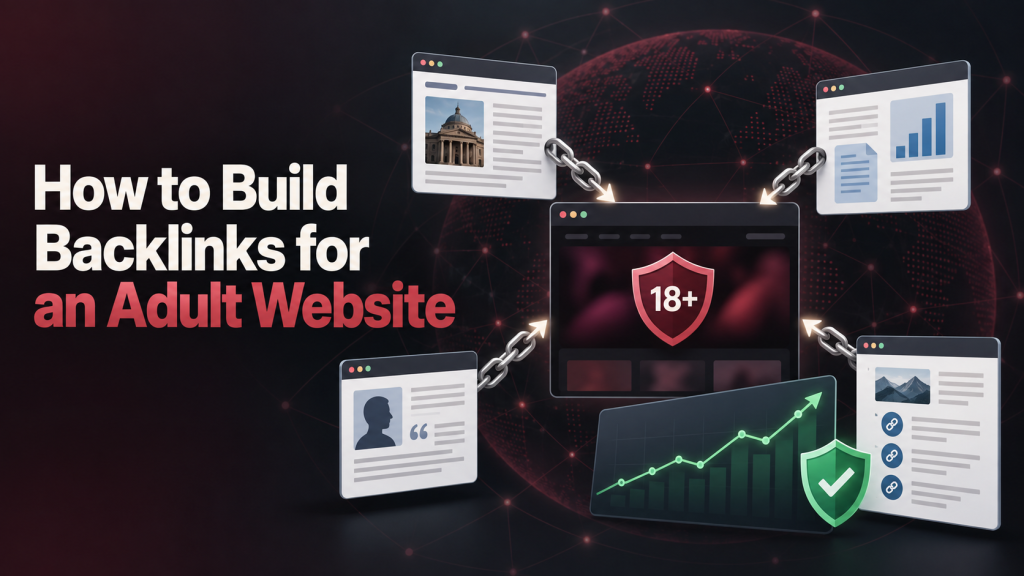
The honest starting point: link building for an adult site is the same discipline as anywhere else, minus about 80% of the available inventory. Every tactic below exists in mainstream SEO. What differs is the hit rate. A mainstream outreach campaign might convert 5–8% of pitches. In adult, on a cold list, 1–2% is a good week.
That is not a reason to buy cheap links instead. It is a reason to be more deliberate about which links you go after.
First, Audit What You Already Have
Roughly half the adult sites we look at have a link problem that new links will make worse. Before adding anything, pull your profile in Ahrefs or Majestic and check four things.
1. Anchor text distribution
Add up your exact-match commercial anchors as a share of the total. Over about 15–20% on a young domain is where we start getting uncomfortable. If someone ran an aggressive campaign before you, the fix is not fewer links. It is a long run of branded and URL anchors to dilute what is there.
2. Where the links point
Most weak adult profiles are 90% homepage links. That is the signature of bought packages, and it does almost nothing for the category, comparison and geo pages that earn money. Healthy profiles are spread across the site.
3. Whether the referring pages get traffic
Sort referring domains by their own organic traffic. If a large share sit at zero, you are looking at network inventory. A page with no readers has nothing to pass.
4. Obvious footprints
Sitewide footer links. Twenty domains that share a template, a hosting range and a publication date. Directories with 4,000 outbound links and no editorial. These are the patterns that get a profile discounted wholesale.
If two or more of those are true, budget the first month for cleanup and dilution rather than acquisition. It is not the exciting answer, but building on top of a compromised profile is how sites stay stuck for years.
The Methods That Actually Work in Adult
Digital PR: the highest ceiling, the most work
The only reliable route to genuinely authoritative mainstream links for an adult brand is to give a journalist something they want independent of who you are. In practice that means data.
You are sitting on data nobody else has. Search patterns by region. Seasonal spikes. Demographic shifts in your signups. Pricing trends across the industry. Anonymise it, aggregate it, write it up properly, and it becomes a story a lifestyle, tech or business desk can run, with a link to the source.
What works: sexual wellness angles, relationship and dating behaviour data, creator economy earnings, AI’s effect on the industry, regulation and age-verification law. What does not: anything that requires the outlet to feature explicit material or endorse the product.
Expect a long lead time. One good digital PR campaign every quarter beats four rushed ones.
Editorial guest placements
Real articles on real publications in and around the niche. The work is in sourcing: finding sites with genuine readers and an editor who will consider adult-adjacent topics, then pitching something their audience actually wants.
The test we apply before placing anything: does the host page get organic traffic of its own, is the site indexed properly, does it publish things other than paid posts, and would we be comfortable if a client clicked through and read it? A surprising share of “DR 60 adult sites” fail all four.
Insertions into existing pages
Placing your link inside an article that already ranks and already earns traffic. Faster than commissioning new content, and often better value because you are not waiting for a new page to age. The risk is that the practice attracts a lot of low-quality inventory: the difference between a good insertion and a bad one is entirely whether the host page is real.
Genuinely useful assets
Underused in adult because it takes patience. Things that earn links without a pitch: a maintained directory of which jurisdictions require age verification and what each law demands; a plain-English guide to payment processing for adult businesses; a free calculator creators actually use. Slow, and the links keep arriving for years.
Partnerships and sponsorships
Industry events, awards, podcasts, community projects. Often overlooked, usually cheap, and the links come with referral traffic and relationships attached.
What to Avoid, and Why
- Private blog networks. Whatever the seller says about footprints, the economics force reuse, and reuse is detectable. When a network goes, every site on it goes together.
- Per-hundred link packages. Nobody can source a hundred real editorial placements for the price these are sold at. The maths only works if the links are worthless.
- Sitewide footer and blogroll links. Enormous link volume, near-zero value, unmistakable pattern.
- Comment, forum and profile automation. Cheap for a reason.
- Reciprocal trades at scale. Two or three partner links are fine. Fifty is a scheme.
Pace and Anchors
Two things get young adult domains filtered more often than anything else: a link velocity that spikes, and an anchor profile that reads like a keyword list.
On pace: look at what your closest competitor gains in referring domains per month and stay in that range. Doubling their rate does not double your results; it just makes your profile the outlier in the comparison set.
On anchors, a distribution that holds up under scrutiny looks roughly like this: branded and URL anchors as the largest share, generic anchors (“this guide”, “here”, “the site”) next, partial-match phrases after that, and exact-match commercial anchors as the smallest slice. If you only remember one thing: exact-match anchors should feel scarce.
How to Judge a Prospect in Ninety Seconds
The check we run on every candidate site, in order:
- Does the domain get organic traffic, and is it trending up or has it fallen off a cliff? A collapsed traffic graph usually means a penalty you would be buying into.
- Does the specific page get traffic, not just the domain?
- How many outbound followed links per article? Consistently high counts mean everything is paid.
- Is the content written for readers or for links? Read one article end to end. You will know.
- Does anything else link to them, from sources they did not buy?
- Is it indexed? Search a distinctive sentence in quotes. If nothing returns, walk away.
Those six checks eliminate most of what gets sold in this industry.
Doing It Yourself vs Paying Someone
In-house works if you have someone who can spend real hours on sourcing and pitching every week, month after month. The tooling is affordable; the time is not. If that person does not exist, campaigns die in month two with a handful of placements and a lot of unanswered emails.
What an agency is actually selling is not access to a secret list. It is the relationships, the rejection rate absorbed on someone else’s time, and the vetting discipline. Judge one on whether they will show you the host pages before placement and whether they will tell you when links are not your problem.
If you want that assessment from us, send the domain and we will pull the profile and tell you what we see: including if the honest answer is that you have a content or indexation problem rather than a link one. Our full range is on the services page, and the wider ranking context is in our adult SEO guide.
Adult Backlinks: Common Questions
What is the best way to build backlinks for an adult site?
Digital PR into mainstream press, if you can produce data worth citing. It is the slowest route and the only one that reaches publications a direct pitch would never open. Below that, editorial placements on genuine adult and adult-adjacent publications, then insertions into existing ranking articles. Everything cheaper than those three is network inventory wearing a different name.
Are backlinks from adult sites bad for SEO?
Not inherently. A link from a real adult publication with real readers, pointing at an adult site, is topically relevant and behaves normally. What causes damage is the profile shape, not the category: sitewide footers, expired-domain networks, hundreds of links from domains with no traffic of their own. Those hurt in any niche. The adult label is not the problem.
Can you buy adult backlinks safely?
Google treats any link acquired for payment as a link scheme, so “safe” is the wrong frame. The real question is risk, and risk is a function of what you buy. Real publications with editorial standards, relevance to your vertical, sensible anchor distribution and a growth rate that matches your competitors sit in a materially different risk position from a package of two hundred links. Anyone selling you compliance is selling you a story.
How many backlinks does an adult site need?
The count is the wrong metric. Pull the two competitors immediately above you, not the market leader, and compare referring domains at the page level for the specific URL you want to rank. That gap is your target. In practice, most adult money pages that reach page one are working with tens of quality referring domains, not hundreds.
Do nofollow links help an adult site?
They pass no ranking credit, but a profile made entirely of followed links is itself a pattern. A natural profile contains both. We report followed and nofollowed placements separately rather than billing one as the other.
How do I check whether a site is worth a placement?
Six checks, about ninety seconds. Does the domain get organic traffic and is it trending up. Does the specific page get traffic, not just the domain. How many followed outbound links per article. Was the content written for readers or for links. Does anything link to them that they did not buy. And is the page actually indexed, which you can test by searching a distinctive sentence in quotes.
Keep reading

Adult Link Building Guide: Working process & Strategies for 2026
Adult link building strategies should do three things: earn references from sites with a real audience, place those references where

Adult Link Building Strategies in 2026
Adult link building strategies should do three things: earn references from sites with a real audience, place those references where

Adult Link Building Cost: Real 2026 Pricing
Real market ranges for adult guest posts, niche edits, PR and retainers — what drives the premium, what you are really paying…
Stop reading about adult links. Start placing them.
Tell us your niche, your target pages and your budget. We reply within one business day with a plan and a price.