
Agency & Pricing 17 min read
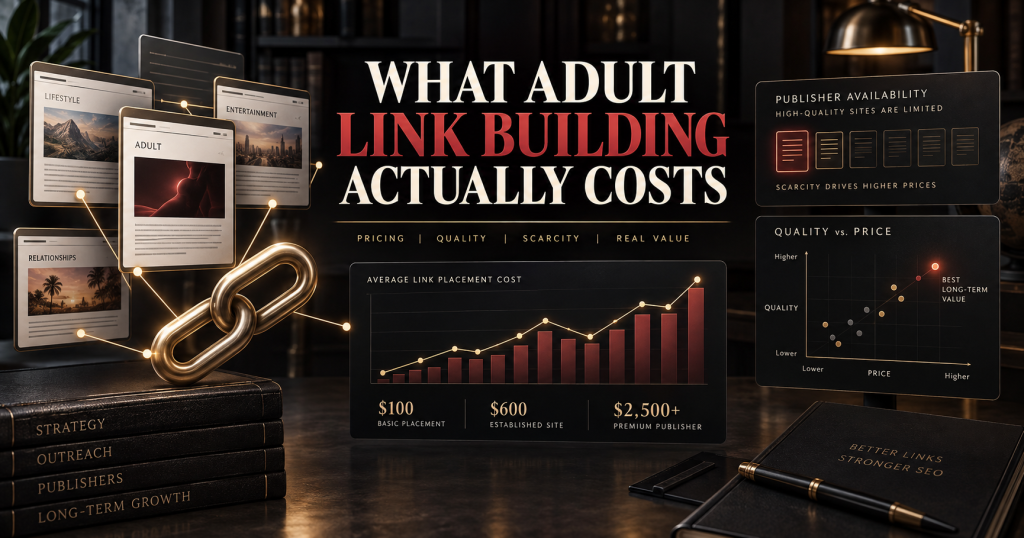
Adult link building typically costs between $100 and $2,500 or more per placement. Most usable adult guest posts fall between $150 and $900, while niche edits commonly cost $100 to $600. Digital PR and fully managed campaigns are normally priced monthly or by project rather than by individual link.
Those ranges are deliberately broad.
A contextual link on a small but legitimate adult publication is not the same product as a feature on an established website with significant organic traffic. Both may appear in a report as “one backlink,” but their cost, risk and potential value are entirely different.
The more useful question is not:
How much should one adult backlink cost?
It is:
What am I receiving for the price, and is that placement appropriate for the page I want to rank?
This guide explains the current adult link-building market, what determines pricing, what agencies include in their fees and how to distinguish an expensive placement from an overpriced one.
Adult Link-Building Prices at a Glance
The following ranges represent broad market orientation in US dollars. They are not guarantees or fixed quotations.
| Link-building service | Typical price | What the price generally covers |
|---|---|---|
| Basic directory or industry listing | Free–$150 | Profile or business listing, usually with limited editorial context |
| Niche edit or link insertion | $100–$600 | Contextual link added to an existing indexed article |
| Guest post on a smaller genuine publication | $150–$400 | New article, editorial review and contextual placement |
| Guest post on an established mid-tier publication | $400–$900 | Stronger readership, traffic and editorial standards |
| Premium editorial placement | $900–$2,500+ | Recognized publication, substantial traffic or scarce niche access |
| Digital PR campaign | $2,500–$10,000+ | Research, campaign asset, journalist outreach and reporting |
| Managed adult link-building campaign | $2,000–$10,000+ per month | Strategy, prospecting, outreach, content, placements and monitoring |
A September 2026 third-party market snapshot covering more than 17,000 adult-category publishers reported a median asking price of $245, with half of the listed prices falling between approximately $125 and $405. In that dataset, guest posts carried a median price of $262, while niche edits had a median of $159. View the adult backlink pricing data.
Marketplace data is useful for understanding the market, but it cannot tell you whether an individual placement is worth buying. That still requires inspecting the website, the proposed page and the editorial context.
Why Adult Backlinks Cost More
Adult placements frequently cost more than comparable mainstream links because the available publisher pool is smaller.
Fewer publishers accept adult businesses
A mainstream campaign may have thousands of viable outreach targets. An adult campaign in a specific sub-niche may have only a few hundred—and many will reject commercial placements regardless of content quality.
A smaller supply combined with sustained demand raises publisher fees.
Outreach takes longer
Adult outreach tends to produce lower response and acceptance rates than outreach for unrestricted industries.
Every successful placement may sit behind:
- Publisher research
- Contact discovery
- Several unanswered emails
- Follow-up messages
- Editorial negotiation
- Content revisions
- Payment administration
- Placement monitoring
Clients do not only pay for the successful email. They also pay for the research and outreach that did not result in a placement.
Publishers evaluate reputational and commercial risk
A mainstream website considering an adult or adult-adjacent link may evaluate how it affects its advertisers, audience and editorial policies.
Sexual-wellness brands may have access to a broader publisher market than explicit tube, escort or cam websites. Two adult businesses requesting links from the same publication can therefore receive different answers and different prices.
Reputable inventory is scarce
Finding a website willing to publish adult links is easy. Finding one with stable traffic, original content, consistent indexing and genuine editorial oversight is much harder.
The price rises when the publisher represents an opportunity that cannot be replaced by hundreds of similar websites.
Adult Guest Post Pricing
An adult guest post is a newly published article containing a contextual link to the client’s website.
You normally pay for three components:
- Access to the publisher
- Creation or editing of the article
- Placement of the contextual link
Smaller genuine publications: $150–$400
At this level, expect a modest website with a consistent publishing history and some verifiable organic visibility.
The site may not have enormous authority, but it should demonstrate:
- Indexed recent articles
- Coherent topical coverage
- Original content
- A plausible audience
- A reasonable outbound-link profile
- Clear ownership or contact information
A relevant smaller publication can be more useful than a high-DR general website with no connection to the target market.
Established mid-tier publications: $400–$900
These websites normally have stronger organic traffic, more recognizable brands or stricter editorial requirements.
The higher price may reflect:
- A real editor reviewing the article
- Stronger topic and audience relevance
- More consistent search visibility
- Fewer commercial links
- Higher content standards
- Greater publisher demand
This is where many sustainable adult campaigns concentrate their budgets.
Premium publications: $900–$2,500+
Premium pricing should purchase something genuinely difficult to replace: substantial traffic, a respected brand, strong topical authority, valuable referral exposure or access to a publication that rarely accepts adult-related businesses.
A high price alone does not make a website premium.
Before paying four figures, verify:
- Where the article will appear
- Whether similar articles receive traffic
- How many commercial links the site publishes
- Whether the proposed topic fits the audience
- Whether the article will be internally linked
- Whether the placement is permanent or time-limited
- How the publisher treats paid or sponsored content
If the seller cannot explain why the opportunity is scarce, the price may reflect markup rather than value.
Learn more about how we source and evaluate adult guest-post opportunities.
Adult Niche Edit Pricing
A niche edit—also called a link insertion—adds a contextual link to an article that is already published.
Most usable adult niche edits cost approximately $100 to $600. They are usually less expensive than a guest post on the same domain because a new article does not need to be written and approved.
However, the value of a niche edit depends primarily on the host page, not the domain.
A worthwhile host page should ideally be:
- Indexed
- Topically relevant
- Receiving organic traffic or impressions
- Internally linked
- Free from excessive commercial outbound links
- Stable enough to retain the placement
A link inserted into a five-year-old article with no traffic, no internal links and no external backlinks is not automatically valuable because the root domain has a strong metric.
Before purchasing a niche edit, request the exact host URL. If the seller will not disclose it before payment, you cannot properly evaluate what you are buying.
See how we assess existing pages for adult niche-edit placements.
Digital PR Costs for Adult Brands
Adult digital PR generally costs between $2,500 and $10,000 or more per campaign or month.
Unlike guest-post pricing, digital PR is not normally calculated by dividing the fee by a guaranteed number of backlinks. You are paying for a campaign that may include:
- Research and data collection
- Survey design
- Expert commentary
- Creative production
- Journalist prospecting
- Media pitches
- Follow-up
- Reactive opportunities
- Reporting
A campaign may earn several strong editorial links, one exceptional link or no coverage at all. Ethical providers cannot guarantee how many journalists will publish a story.
Digital PR is expensive because the links it can earn are difficult for competitors to copy. A successful campaign may secure editorial coverage from publications that would never accept a conventional adult guest-post proposal.
The format works best when the adult business can contribute something relevant to a wider discussion, such as:
- Consumer behavior data
- Relationship trends
- Online-safety research
- Creator-economy insights
- Sexual-wellness education
- Privacy or technology expertise
- Industry statistics
Learn more about our approach to adult digital PR.
Managed Adult Link-Building Retainers
Managed campaigns commonly cost between $2,000 and $10,000 or more per month.
A retainer should purchase more than a monthly allocation of links. It should include the strategic and operational work surrounding those placements.
Depending on the provider, a managed campaign may include:
- Backlink-profile analysis
- Competitor link-gap research
- Target-page selection
- Keyword and anchor planning
- Publisher prospecting
- Outreach and negotiation
- Content production
- Client approval
- Placement monitoring
- Replacement terms
- Monthly reporting
The appropriate budget depends on the competitive gap—not an arbitrary number of links.
A specialist dating website competing nationally may require a substantially larger program than a creator trying to control search results for a personal brand name.
What You Are Actually Paying For
Publisher fees are only one component of professional link-building costs.
Prospecting
Someone must identify websites that are relevant, active and realistically open to the client’s category.
A large raw list is not the same as a qualified prospect list. Good prospecting eliminates unsuitable websites before time or money is spent contacting them.
Vetting
Every potential publisher should be evaluated for:
- Organic traffic
- Traffic direction
- Ranking keywords
- Recent indexation
- Domain history
- Topic consistency
- Outbound-link patterns
- Advertised or obvious link selling
- Malware or security issues
- Editorial quality
- Audience and country relevance
Most discovered websites should not survive this process.
Outreach and negotiation
Publisher outreach involves finding the correct contact, presenting an appropriate topic, handling follow-ups, agreeing terms and confirming the placement.
Adult outreach also requires understanding which angles different publishers will consider. A sexual-wellness story, business analysis or consumer study may be acceptable where a direct commercial pitch is not.
Content production
A guest post must be useful enough to belong on the publisher’s website.
The article should satisfy the host audience while creating a natural reason to cite the target page. Thin promotional copy may secure a weak placement, but it rarely produces something worth retaining.
Strategy
A good website can still produce a poor outcome when the wrong page or anchor is selected.
Strategy includes deciding:
- Which target page needs authority
- Which keyword cluster matters commercially
- Which placement type fits the goal
- What anchor text is appropriate
- Whether the page is ready to receive links
- How quickly new placements should be acquired
- How the new links fit the existing backlink profile
Monitoring and replacement
Links disappear. Pages are redirected. Publishers change ownership. Articles become deindexed.
A managed service should specify:
- How long placements are monitored
- When a lost link qualifies for replacement
- Whether changes to the link attribute are covered
- What happens when the host page is removed
- How replacements are reported
A cheaper quote without monitoring may become more expensive when placements disappear unnoticed.
What Determines the Price of an Adult Backlink?
Organic traffic
Sustained organic traffic is a useful sign that the website has pages search engines continue to surface.
Traffic is not proof that a specific link will improve rankings, but it provides more context than an isolated authority score.
Ask for both site-level and page-level information.
Topical relevance
A relevant link provides a clearer editorial relationship between the publisher, article and destination page.
Relevance may exist at different levels:
- The entire domain covers the same industry.
- A site section covers a closely related topic.
- The individual article provides appropriate context.
- The publisher reaches the same audience through an adjacent subject.
Not every useful link needs to come from an explicitly adult domain. Technology, business, privacy, health and creator-economy publications may be relevant when the editorial connection is legitimate.
Authority metrics
DR, DA and similar scores are third-party estimates. They can help compare websites, but they are not Google metrics and should never be used alone.
A high authority score combined with negligible traffic, inconsistent topics and an aggressive outbound-link profile deserves investigation—not a premium price.
Country and language
English-language placements in the United States and United Kingdom frequently cost more because competition and publisher demand are higher.
Native-language outreach can also be expensive when the target market has few suitable publishers.
The correct link is not simply one from a strong domain. It should support the geographic and linguistic market the business wants to reach.
Link placement
A contextual editorial link within the main article is different from a link placed in:
- An author biography
- A footer
- A sidebar
- A directory profile
- A sponsored-content box
- An unrelated sentence added after publication
Request the proposed position and surrounding text before approval.
Link attributes
Paid and sponsored links should be properly qualified under Google’s guidance, normally using rel="sponsored" or rel="nofollow".
A seller promising a “guaranteed dofollow link that passes maximum authority” is describing an attempt to influence rankings, not a risk-free editorial service.
Permanence and replacement terms
Some placements are sold as permanent but only guaranteed for six or twelve months. Others function as annual rentals.
Clarify:
- The guaranteed live period
- Whether renewal fees apply
- What circumstances qualify for replacement
- Whether the entire page or only the link is covered
- Who monitors the placement
Expensive Versus Overpriced
An expensive placement can be justified when it provides:
- A relevant audience
- Verified organic visibility
- Strong editorial standards
- Limited commercial outbound links
- A credible publication history
- A host page with independent value
- Referral or brand exposure
- An opportunity competitors cannot easily reproduce
An overpriced placement relies primarily on:
- A high DR or DA number
- An impressive homepage with weak internal pages
- Traffic unrelated to your market
- A site that publishes every restricted category
- A placement on an orphaned article
- Artificial urgency
- No pre-approval
- No replacement terms
The difference is evidence.
If a provider cannot show the website, proposed page, traffic context, price and placement conditions before publication, you are being asked to buy a metric rather than evaluate an asset.
Warning Signs Behind Suspiciously Cheap Links
Low pricing is not automatically proof of poor quality. It should, however, trigger closer inspection.
Be particularly careful when a seller offers:
- Hundreds of immediately available adult websites
- Guaranteed publication within hours
- Only DR or DA as evidence
- Identical pricing across every niche
- Dozens of links for the cost of one editorial article
- No ability to approve publishers
- Exact-match anchors across every placement
- Websites covering adult, casino, CBD, crypto and unrelated topics simultaneously
- Guaranteed rankings
- No monitoring or replacement policy
Independent publishers do not usually behave like unlimited inventory. When every placement is instantly available, the seller may control the network or repeatedly resell the same group of websites.
Per-Link Pricing or Monthly Retainer?
Per-link pricing
Pay-per-placement pricing works well when:
- You understand target-page and anchor strategy.
- You need a limited number of placements.
- You want to test a provider.
- You have internal SEO oversight.
- You require control over individual purchases.
Its main advantage is transparency. The disadvantage is that strategy, content, monitoring and reporting may be charged separately or omitted entirely.
Monthly retainers
A retainer is more appropriate when:
- Link building is an ongoing acquisition channel.
- Multiple pages or markets are involved.
- Competitor activity needs monitoring.
- Strategy must change as ranking data develops.
- You do not have an internal outreach team.
- Consistent reporting and replacements matter.
Do not compare a managed monthly fee directly with a marketplace publisher fee. They represent different scopes of work.
How to Set an Adult Link-Building Budget
Start with the competitive gap rather than selecting an arbitrary link count.
Step 1: Confirm that the page is ready
Before acquiring links, check that the target page:
- Is indexed
- Matches the intended search intent
- Has useful original content
- Is internally linked
- Has a clear conversion path
- Is technically accessible
- Is not competing with another page on the same website
Links cannot reliably rescue a page that search engines do not consider useful or indexable.
Step 2: Compare the correct competitors
Evaluate websites immediately above you—not only the largest brand in the market.
Review:
- Referring domains to the ranking page
- Quality and relevance of those domains
- Domain age and overall authority
- Content depth
- Internal linking
- Brand demand
- Search intent
This provides a more realistic estimate of the authority gap.
Step 3: Concentrate the initial campaign
A focused campaign usually produces clearer information than spreading a limited budget across the entire website.
Select:
- One priority commercial page
- One closely related keyword cluster
- A small number of supporting pages
- A defined evaluation period
The objective is not to force every link toward one URL indefinitely. It is to create a campaign focused enough to measure.
Step 4: Preserve a testing budget
Do not commit the entire quarter’s budget before seeing which placement types, publishers and target pages respond.
A sensible program leaves capacity to:
- Replace failed placements
- Pursue an unexpected opportunity
- Adjust the target-page mix
- Change publisher tiers
- Support content that begins gaining visibility
Example monthly budgets
| Monthly budget | Practical approach |
|---|---|
| Under $1,000 | Improve the target page first; selectively acquire one or two verifiable placements |
| $1,000–$2,500 | Focus on one keyword cluster with a mixture of smaller guest posts and carefully selected niche edits |
| $2,500–$5,000 | Run consistent outreach with stronger publisher diversity, content support and monitoring |
| $5,000–$10,000+ | Compete across multiple pages or markets and incorporate premium editorial or digital PR opportunities |
These are planning ranges, not promises of performance. A lower-competition campaign may require less, while a national commercial term may require considerably more.
How to Evaluate Link-Building ROI
The cheapest cost per link is not necessarily the lowest cost per result.
A simple commercial model is:
Additional organic visits × conversion rate × profit per conversion = estimated monthly return
For example, assume a target page gains 1,000 additional monthly visits, converts 2% of those visitors and produces $100 in profit per conversion:
1,000 × 2% × $100 = $2,000 estimated monthly profit
That does not prove which link caused the improvement. Rankings are affected by content, technical changes, internal links, competition and algorithm updates.
It does provide a more useful framework than judging a campaign by the number of links delivered.
Measure:
- Target-page impressions
- Non-branded clicks
- Ranking distribution
- Qualified leads or sales
- Revenue from organic search
- Live-link retention
- Referral traffic
- Cost per acquired customer
A link that costs $700 and contributes to a profitable commercial page may be less expensive than a $70 link that produces no measurable value.
The Google Policy Question
Google’s spam policies identify buying or selling links for ranking purposes as link spam. Google recommends marking paid placements with rel="sponsored" or rel="nofollow".
No responsible agency should describe a paid placement as “Google-approved” or risk-free.
The honest distinction is between:
- Earning editorial coverage through useful information, expertise or original research
- Paying for properly disclosed advertising or sponsorship
- Purchasing links specifically to manipulate organic rankings
Businesses should understand which activity they are funding and the associated policy risk. Read Google’s guidance on qualifying outbound links and its link-spam policies.
Questions to Ask Before Accepting a Quote
Before paying for an adult link-building campaign, ask:
- Can I approve every publisher before publication?
- Will I see the proposed host page for niche edits?
- What are the website’s traffic source and geographic distribution?
- Are recent articles indexed?
- What topics does the website normally publish?
- How many commercial outbound links appear on similar pages?
- Is content creation included?
- Where will the link appear?
- Which link attributes will be used?
- Is the placement permanent or rented?
- What monitoring and replacement terms apply?
- Will I receive the live URL, anchor and target-page record?
- How will target pages and anchors be selected?
- What happens if you determine my page is not ready for links?
- Do you guarantee rankings?
The correct answer to the final question is no. An agency can guarantee its process, deliverables and reporting. It cannot control Google’s results.
Frequently Asked Questions
How much does one adult backlink cost?
One adult backlink commonly costs between $100 and $2,500 or more. Most useful niche edits fall between $100 and $600, while guest posts on genuine publications commonly range from $150 to $900. Premium editorial placements may exceed $2,500.
Why are adult backlinks more expensive?
Adult backlinks cost more because fewer reputable publishers accept adult businesses. Lower outreach success rates, additional vetting and limited inventory increase the cost of securing appropriate placements.
Are niche edits cheaper than guest posts?
Niche edits are usually cheaper because they add a link to an existing page rather than requiring a new article. However, their value depends on the relevance, traffic and authority of the specific host page.
Is a high-DR backlink worth more?
Not automatically. DR is a third-party metric and can be manipulated. Review organic traffic, ranking keywords, domain history, relevance, editorial quality and the proposed host page before deciding what a placement is worth.
Is cheap adult link building worth it?
Occasionally, a smaller legitimate website may offer a reasonably priced opportunity. Extremely cheap bulk packages usually remove important work such as prospecting, vetting, original content or monitoring. Evaluate the actual publishers rather than assuming every low price is a bargain—or every high price indicates quality.
What should an adult link-building retainer cost?
Managed adult link-building retainers commonly range from $2,000 to $10,000 or more per month. The price depends on campaign volume, publisher quality, content requirements, market competition and whether technical or content strategy is included.
Should I pay per link or use a monthly campaign?
Pay-per-link pricing works for controlled, limited purchases when you already have SEO strategy in place. A managed campaign is more appropriate when you need ongoing prospecting, target-page strategy, anchor planning, monitoring and reporting.
Can an agency guarantee rankings?
No. Agencies do not control search algorithms, competitors or future updates. Treat guaranteed ranking claims as a warning sign.
Get a Price Based on Your Actual Competition
Adult link building can cost $100 or $2,500 for what appears in a report as the same deliverable: one backlink.
The difference lies in the publisher, host page, audience, editorial context, scarcity and work required to secure it.
A useful quote therefore needs more than your preferred number of links. It needs:
- Your domain
- Your priority pages
- Your target market
- Your important keywords
- Your closest search competitors
- Your existing backlink profile
- Your available budget
Request a free backlink audit and we will identify whether authority is genuinely holding the website back, estimate the competitive gap and recommend a campaign size grounded in the market—not an arbitrary package.
Keep reading

Adult Link Building Guide: Working process & Strategies for 2026
Adult link building strategies should do three things: earn references from sites with a real audience, place those references where

Adult Link Building Strategies in 2026
Adult link building strategies should do three things: earn references from sites with a real audience, place those references where

How to Build Backlinks for an Adult Website
A practical guide to acquiring links for adult sites: audit first, the five methods that work, what to avoid, and how to…
Stop reading about adult links. Start placing them.
Tell us your niche, your target pages and your budget. We reply within one business day with a plan and a price.